
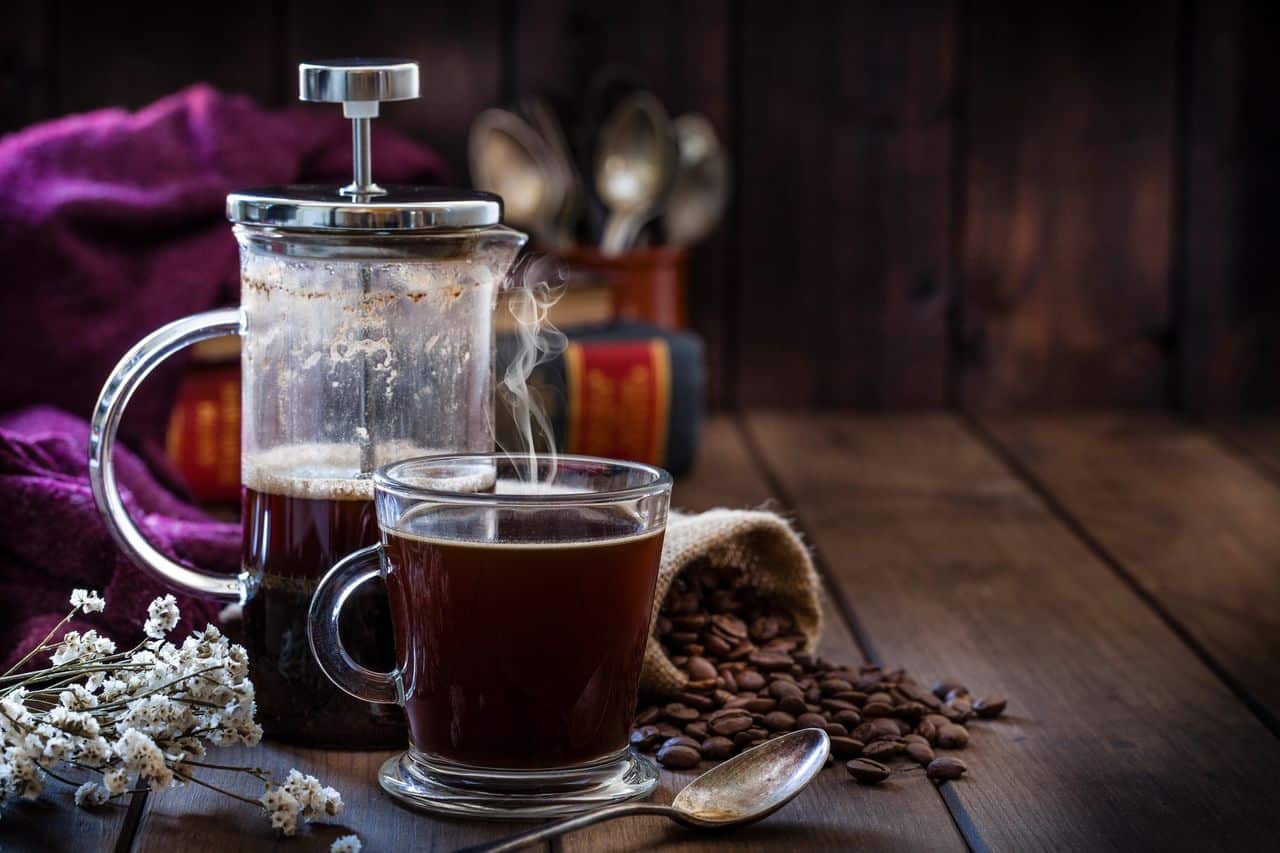
The French press traces back to an 1852 French patent for a piston-style coffee filter, was refined by a Milanese company in the late 1920s and 1930s, and became popular in American coffee culture in the 1980s. Here’s the story behind one of coffee’s most enduring brewers.
Few devices hold as much charm and legacy as the French press. Coffee historian William Harrison Ukers, in his 1922 classic All About Coffee, argued that the French showed a unique passion for coffee brewing — yet, interestingly, even Ukers overlooked the simple plunger-style vessel we now call the French press.
The First Patent

The French press’s journey began long before it became popular. The first patent for a piston-style coffee-filtering device was granted in March 1852 to a Parisian metalsmith and a merchant. Their invention used a rod attached to a piece of perforated tin, layered between two pieces of flannel. Pressing the rod down into a cylindrical vessel produced clear, filtered coffee above — the basic principle every French press still uses today.
From Paris to Milan
Despite that early French origin, it wasn’t until the late 1920s that a Milanese company patented its own version. Over the years they refined the design, culminating in a 1935 model with a spring mechanism that kept the plunging disc flush against the cylinder — a big improvement in usability.
As coffee shops spread across Europe in the 1950s, the French press grew in popularity. It took longer to reach cafés in the United States, and Americans were even divided on what to call it — some borrowed the British “cafetière,” others said “French plunger-type” coffee maker.
Reaching American Coffee Culture

The French press didn’t really catch on in the U.S. until the early 1980s, when food critic Florence Fabricant highlighted its appeal in a New York Times article. By then, connoisseurs celebrated it for producing a rich, full-bodied brew — though, as Fabricant noted, it could occasionally turn out a little muddy from fine particles, which is why grind size matters so much (see our grind size chart).
The Timeless Brew
Today the French press endures as a staple in coffee shops, cafés, and homes worldwide, evoking a sense of nostalgia and tradition. It has transcended its humble beginnings to become synonymous with the passion for coffee brewing. So next time you press a rich cup, remember the generations of devotees behind this beloved device.
The French press shines with a coarse grind and fresh, full-bodied beans — our medium and dark roasts are made for it. Shop fresh-roasted coffee, roasted to order in Concord, CA, and give your press the beans it deserves.


