
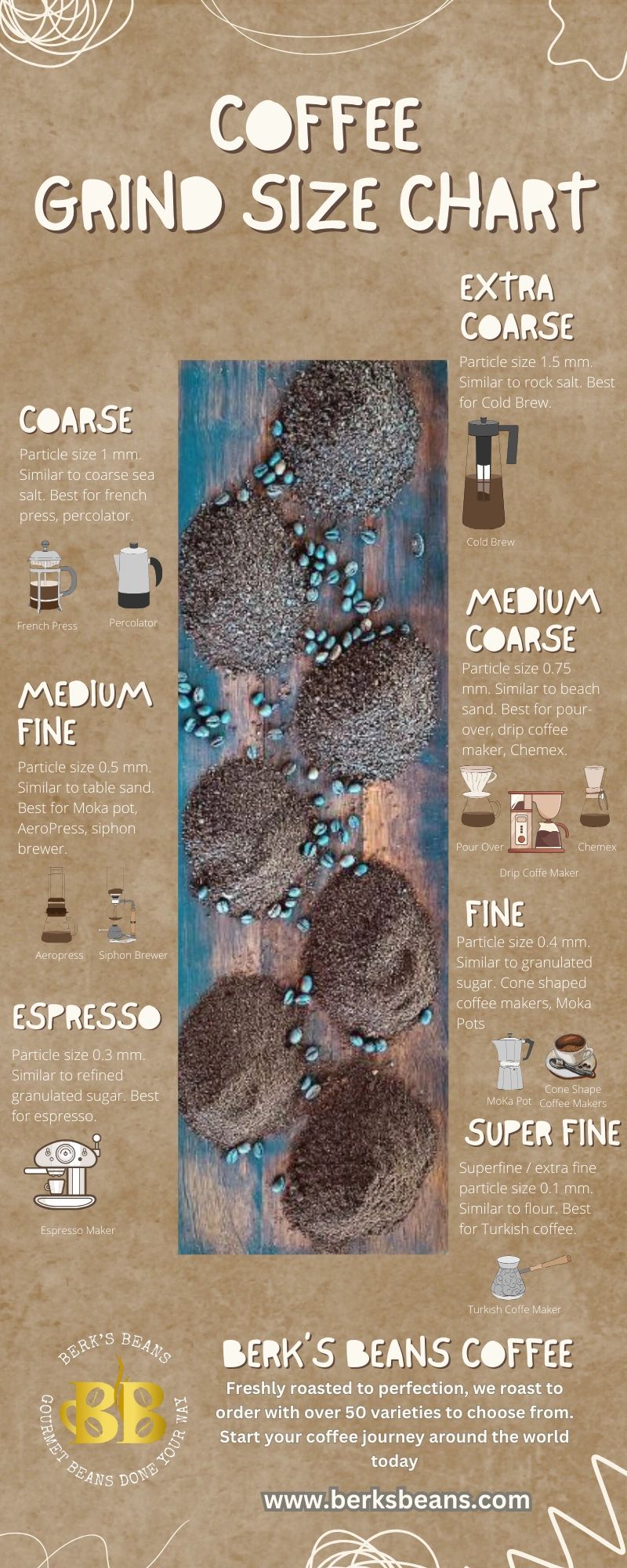
Quick answer: match your grind to your brew method — extra coarse for cold brew, coarse for French press, medium for drip, medium-fine for pour-over, fine for espresso, and extra fine for Turkish. The finer the grind, the faster coffee extracts. Full chart and settings below.
The single biggest variable in home coffee brewing that most people get wrong is grind size. Too coarse, and your coffee is thin, sour, and under-extracted. Too fine, and it’s bitter, astringent, and over-extracted. Getting grind size right is the difference between a flat cup and a great one. This chart from Berk’s Beans Coffee breaks down the full grind size spectrum, matches each size to its ideal brew method, and explains how to fine-tune for your specific equipment.
The Coffee Grind Size Spectrum
Coffee grind size is measured both qualitatively (coarse, medium, fine) and quantitatively in microns — the diameter of the ground coffee particles. Commercial burr grinders let you dial in these sizes with precision; home blade grinders do not (which is why burr grinders are strongly recommended for serious brewing). Here is the full spectrum from coarsest to finest:
| Grind Size | Particle Size | Visual Reference | Primary Brew Methods |
|---|---|---|---|
| Extra Coarse | 1,500–1,000 μm | Peppercorns | Cold brew, cowboy coffee |
| Coarse | 1,000–800 μm | Kosher salt | French press, percolator |
| Medium-Coarse | 800–600 μm | Rough sand | Chemex, Clever dripper |
| Medium | 600–500 μm | Beach sand | Drip machines, flat-bottom pour over (Kalita Wave) |
| Medium-Fine | 500–400 μm | Fine sand | Cone pour over (V60, Melitta), AeroPress (standard) |
| Fine | 400–200 μm | Table salt / granulated sugar | Espresso, moka pot, AeroPress (short steep) |
| Extra Fine | <200 μm | Powdered sugar / flour | Turkish coffee, ibrik |
Grind Size by Brew Method — Recommended Settings
Cold Brew (Extra Coarse)
Cold brew relies on a long 12–24 hour extraction in cold water, so it needs the coarsest grind to prevent over-extraction and bitterness. The low water temperature pulls fewer bitter compounds than hot brewing, so you get a smooth, chocolatey concentrate. If your cold brew tastes muddy or overly bitter, your grind is too fine — coarsen it. (See our full guide to making cold brew at home.)
French Press / Percolator (Coarse)
A coarse grind is essential for immersion brewing in a French press. The mesh filter lets through anything smaller than about 200 μm, so a fine grind creates sediment and a gritty cup. Steep for 4 minutes, plunge slowly, and decant immediately to prevent continued extraction. (One exception: a French press espresso-style shot uses a much finer grind.)
Chemex (Medium-Coarse)
The Chemex uses a thick bonded paper filter that slows water flow significantly. A medium-coarse grind gives water the right contact time — not so fast that extraction is incomplete, not so slow that it over-extracts and clogs the filter.
Drip Machines / Kalita Wave (Medium)
Most standard drip coffee machines target a medium grind — roughly the texture of beach sand. This size balances flow rate, contact time, and extraction across the typical 4–6 minute brew cycle of a home drip machine. Pair it with the right dose using our coffee-to-water ratio guide.
V60 / Pour Over (Medium-Fine)
Cone-shaped pour overs like the Hario V60 require a slightly finer grind than flat-bottom devices because water flows through a smaller filter footprint. Target 400–500 microns for a 3–4 minute total brew time. New to the method? See how to make pour over coffee.
Espresso (Fine)
Espresso demands a fine, uniform grind — typically 200–400 microns — to create the pressure resistance needed for a 25–32 second extraction through a portafilter. Espresso grind is by far the most sensitive to calibration: a single grind-step change can shift shot time by 5+ seconds. If your shot runs in under 20 seconds, grind finer. If it runs over 35 seconds, grind coarser.
Moka Pot (Fine, but looser than espresso)
Stovetop moka pots like the Bialetti need a fine grind but not quite as fine as espresso — think table salt rather than powdered sugar. Too fine and the steam pressure can’t force water through the puck; too coarse and you get weak, watery coffee.
Turkish / Ibrik (Extra Fine)
Turkish coffee is ground to a powdered-sugar consistency so that it disperses fully into the water when boiled. This is so fine that most home grinders can’t produce it — Turkish grind is traditionally produced in a manual hand mill.
How Grind Size Affects Extraction
Grind size directly controls extraction rate — how quickly soluble compounds dissolve from the coffee grounds into the water. Smaller particles have more surface area relative to their volume, so water extracts from them faster. The three phases of extraction happen in sequence:
- Acids and fruity notes extract first (0–30% of extraction). Under-extracted coffee tastes sour and thin because you’ve only pulled these early compounds.
- Sugars and balanced flavors extract next (30–60%). This is the “sweet spot” where most single origins taste their best.
- Bitter compounds and plant-astringents extract last (60–100%). Over-extracted coffee tastes dry, bitter, and harsh.
The SCA Gold Cup standard targets an extraction yield of 18–22% — meaning 18–22% of the coffee’s dry mass should dissolve into the final cup. Grind size is one of the four primary levers you use to hit that window (along with water temperature, contact time, and dose ratio).
Troubleshooting by Taste
- Sour, thin, or sharp cup → Grind finer. You’re under-extracting.
- Bitter, dry, or astringent cup → Grind coarser. You’re over-extracting.
- Muddy or overly full-bodied (especially in French press) → Grind coarser. Particles are too small for the filter.
- Watery espresso running fast → Grind finer. Not enough resistance.
- Espresso choking or running extremely slow → Grind coarser. Too much resistance.
Blade vs. Burr Grinders
One of the biggest quality upgrades a home brewer can make is switching from a blade grinder to a burr grinder. Blade grinders chop beans randomly, producing a mix of fine dust and large chunks that extract unevenly — you get both sour under-extracted chunks and bitter over-extracted fines in the same cup. Burr grinders crush beans between two abrasive surfaces at a fixed distance, producing uniform particles that extract evenly. If you can only invest in one piece of coffee equipment, make it a burr grinder. (See our picks for the best grinder for drip and the best grinder for cold brew.)
Frequently Asked Questions
What grind size is best for drip coffee?
A medium grind — about the texture of beach sand. It balances flow and extraction over a standard drip machine’s 4–6 minute cycle.
What happens if my grind is too fine?
You over-extract, which makes coffee bitter and astringent. In a French press, too-fine grounds also slip through the mesh and leave a gritty, muddy cup.
What grind should I use for a French press?
Coarse — roughly the size of kosher salt. It keeps sediment out and prevents over-extraction during the long steep.
Can I use one grind size for every brew method?
You can, but you shouldn’t expect great results. Each method has an ideal contact time, and matching grind size to method is the easiest way to improve your cup.
Do I really need a burr grinder?
For consistent results, yes. Burr grinders produce uniform particles that extract evenly, while blade grinders create dust and chunks that extract unevenly in the same cup.
Shop Quality Coffee from Berk’s Beans
Grinding is only half the equation — you need fresh, high-quality beans to start with. At Berk’s Beans, we roast to order and ship within 72 hours, so every bag you receive is at the peak of its flavor window. Shop our full coffee selection at berksbeans.com, or explore unroasted Berk’s Beans Greens if you want to roast your own at home. Our team is happy to recommend a grind size for your specific equipment — just reach out at beanteam@berksbeans.com or (925) 588-9164.
Sources & Citations
- Specialty Coffee Association — Coffee Standards — Gold Cup extraction targets of 18–22% yield
- SCA Research Library — Brewing science and roast curve guidance
- Food & Function Journal (2020) — Coffee particle size and extraction kinetics


