

Quick answer: to make pour over coffee, rinse your filter, add medium-coarse grounds, and pour water heated to 195–205°F in slow spirals — starting with a 15-second bloom, then two or three pours — at about a 1:16 coffee-to-water ratio. The whole brew takes roughly 3 minutes and produces a clean, bright, flavorful cup. Here’s the full method.
How to Make Pour Over Coffee: Step by Step
- Heat your water to 195–205°F. If it comes to a rolling boil, let it rest about 20–30 seconds.
- Set up the dripper. Place your pour-over brewer (like a V60) on your mug and add a paper filter.
- Rinse the filter with a few ounces of hot water to remove any papery taste and warm the mug, then discard that water.
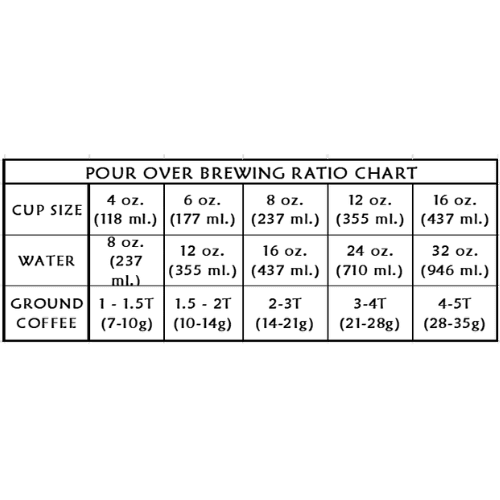
- Grind fresh. Grind whole beans to a medium-coarse texture and add them to the filter — see our grind size chart and ratio guide for amounts.
- Bloom. Pour just enough water to wet all the grounds, spiraling from the outer rim inward (about 15 seconds of pouring). The coffee will “bloom” and puff up as it releases gas. Wait about 30 seconds.
- Second pour. Pour more water in slow spirals from the center outward. Let it drain most of the way.
- Final pour. Add the remaining water the same way until you’ve hit your target amount, then let it finish dripping.
- Remove the dripper and enjoy your fresh cup.

Why Pour Over Coffee Is Worth the Extra Effort
In a world of push-button convenience, pour over asks you to slow down — and the payoff is a cup that’s cleaner, brighter, and more complex than any automatic machine can produce. You control every variable: water temperature, pour rate, bloom time, and total brew time, and that control translates directly to flavor. It’s also affordable: a basic dripper runs about $15, a gooseneck kettle $30–50, and a good scale $10–15 — under $100 for a café-quality setup.
Pour Over Ratios
The most common pour over ratio is 1:15 to 1:17 by weight (grams of coffee to grams of water). Practical starting points:
| Cup size | Coffee | Water |
|---|---|---|
| Single cup | 18–20 g | 300 ml |
| Large cup | 30–33 g | 500 ml |
| Chemex (6-cup) | 50–55 g | 800 ml |
These are starting points, not rules. Too strong? Use less coffee or more water. Too weak? The reverse. Adjust in 1–2 gram increments until it’s dialed in.
Common Pour Over Mistakes to Avoid
- Skipping the filter rinse: always wet the paper first — it removes the papery taste and seals the filter to the brewer.
- Using boiling water: 212°F scorches delicate flavors. Rest the kettle 30–45 seconds or set a temperature-controlled kettle to 200°F.
- Pouring too fast: rushing means water runs through before extracting fully. Slow, controlled spirals extract evenly.
- Using stale beans: pour over hides nothing — use beans roasted within the last 14 days, and see our bean storage guide.
- Inconsistent grind: a burr grinder produces uniform particles for even extraction; a blade grinder gives you both under- and over-extracted notes in one cup.
Best Coffee for Pour Over Brewing

Pour over is the ideal method for showcasing single-origin coffees — the clean extraction highlights fruity notes, floral aromas, and bright acidity that a French press or drip machine can mute. Light and medium roasts are the best match. For picking beans, see our guide to the best coffee beans for pour over.
At Berk’s Beans, our single-origin coffees are roasted to shine in pour over and shipped within 72 hours of roasting. Browse our selection and find your perfect cup.
Frequently Asked Questions
What grind should I use for pour over?
A medium to medium-fine grind, roughly the texture of table salt to fine sand. Too coarse gives a weak, sour cup; too fine clogs the filter and over-extracts.
What’s the ideal water temperature for pour over?
195–205°F. Just off the boil is perfect — boiling water can scorch the coffee and add bitterness.
Do I need a gooseneck kettle and scale?
They help a lot. A gooseneck gives you a slow, controlled pour, and a scale lets you nail the ratio every time — but you can still make good pour over without them by pouring carefully.


